Callsign Prefixes: How to Tell Which Country a Station Is From
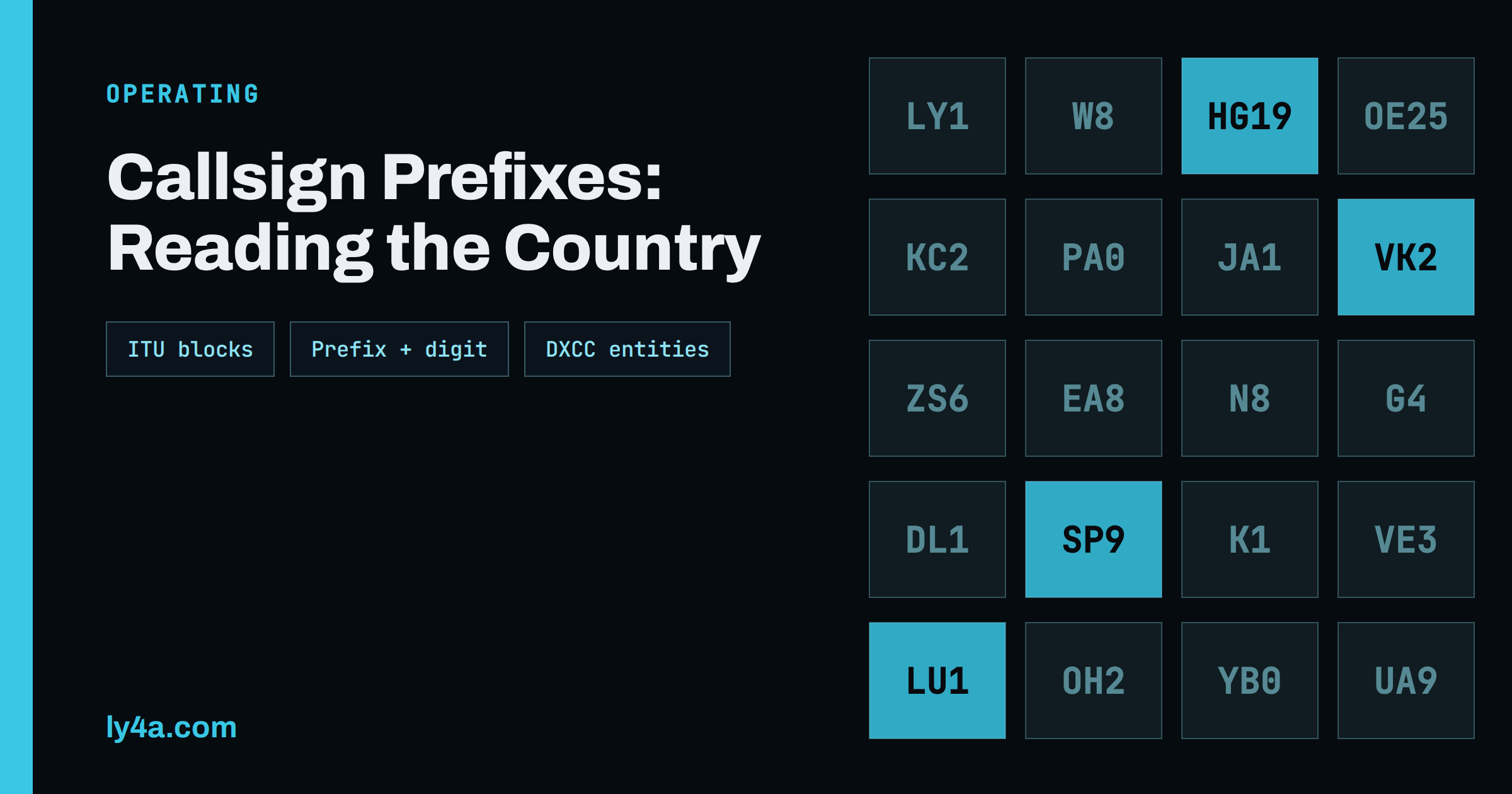
The first thing you hear in a pileup is a call sign, and within a second an experienced operator knows which country it comes from. That skill is not magic. It rests on callsign prefixes, the first one to three characters that the International Telecommunication Union allocates to each country. Learning how they work helps you chase DX, log contacts correctly, understand contest multipliers and avoid embarrassing mistakes when a call sign does not mean what you assumed. This guide explains the structure of an amateur call sign, how the ITU allocates blocks, what slashes and extra characters mean, why special event calls look odd and where prefixes and DXCC entities part company.
Even if you already recognise the usual suspects such as DL, SP or JA, the exceptions are where the real learning happens. Islands, territories, special events and portable operation all bend the rules in ways that matter for your log and for awards.
The Structure of a Call Sign
A call sign in amateur radio has three parts: a prefix, a separating numeral and a suffix. As the encyclopedia entry on amateur radio call signs explains, prefixes are assigned internationally and are a form of country code, and a separating numeral plus suffix are added by a national body to produce a unique identifier. The rules come from the ITU Radio Regulations, which require each country to assign call signs to its operators that begin with the characters allocated to that country or its territories.
The prefix may have one, two or three characters. The same source gives examples of how the parts fit together:
- K4X has the prefix K, the numeral 4 and the suffix X, a pattern that is often used for time-limited special event stations in the United States.
- HL1AA has the two-character prefix HL, the numeral 1 and the suffix AA, from South Korea.
- 4X4AAA begins with the prefix 4X, then the numeral 4 and the suffix AAA, from Israel.
- 3DA0RS has a three-character prefix, 3DA, the numeral 0 and the suffix RS, from Eswatini.
The numeral does not always indicate a region, but in many countries it does. In the United States it was historically tied to the call area, and operators from Japan, Canada and Australia also use numerals to mark districts. Treat the number as a hint, never as a guarantee of where the station is.
How the ITU Allocates Prefix Blocks
The ITU allocates call sign prefixes to radio and television stations of all types, and the published allocation table serves amateur radio as well. A country must use only call signs that begin with its allocated characters. The allocation works in ranges of letters. If a country receives every letter from A to Z in the second or third position, it can also use digits there. The United States, for example, is assigned KA to KZ and can therefore use prefixes such as K1 and K9.
The ITU table shows how varied the blocks are:
- Lithuania has LYA to LYZ, which is why Lithuanian amateurs all start with LY. The neighbours differ: Latvia uses YL and Estonia uses ES. After the annexation of the Baltic states in 1940 the Soviet Union inherited their prefixes, and when they regained independence the countries resumed the earlier calls.
- Germany has two blocks, DA to DR and Y2 to Y9, so a Y2 or Y9 call sign can also be German.
- Greece has J4 and SV to SZ.
- France has several ranges, including F, HW to HY, TH, TK, TM, TO to TQ and TV to TX, which explains why call signs with a TK or TM prefix surprise newcomers.
- The L series is split many ways: Norway has LA to LN, Argentina LO to LW, Luxembourg LX, Lithuania LY and Bulgaria LZ.
The lesson is that you cannot guess a country from the first letter alone. Memorise the prefixes you work often, and use a table or a program for the rest.
Examples at a Glance
| Call sign | Prefix | ITU block and country | What to notice |
|---|---|---|---|
| LY2ABC | LY | LYA to LYZ, Lithuania | The numeral and suffix come from the national scheme, not from the ITU prefix |
| DL1ABC | DL | DA to DR, Germany | Germany also holds Y2 to Y9 |
| SV1ABC | SV | SV to SZ, Greece | Greece also holds J4 |
| 3DA0RS | 3DA | 3DA to 3DM, Eswatini | A three-character prefix with the numeral 0 |
| K4X | K | KA to KZ, United States | A very short special event style |
| I20000X | I | I, Italy | A long suffix used for a special event |
Slashes, Portable Operation and Visiting Operators
Many call signs you hear on the air carry a slash. The rules differ between countries, but the common forms are these:
- /P for portable operation and /A for operation from an alternative location registered with the licensing authority. Some regulators require them, others only recommend them.
- A numeral after the slash to show a different call area within the same country. The encyclopedia gives the example of an Australian from Queensland operating in Tasmania who can sign VK4xxx/7 or VK4xxx/VK7.
- A visiting prefix when you operate abroad. In countries that apply the CEPT recommendation T/R 61-01, a visitor puts the host country’s prefix before the home call sign. A British amateur holding G3xxx who visits France signs F/G3xxx. A Lithuanian visitor to Germany would sign DL/LY1ABC in the same way. Our guide to operating abroad under CEPT T/R 61-01 explains the licence side.
The same source warns that /M, /AM and /MM cannot be used as prefix-style additions, because M, AM and MM are themselves prefixes assigned to nations: M for England, MM for Scotland and AM for Spain. Mobile and maritime mobile operation is therefore normally signalled with a suffix after the call sign, and the national rules decide what is required in your country.
When you log a call sign with a slash, work out which part is the prefix and which is the suffix. A log program with a country file does this for you, but you should still check unusual cases by eye.
Special Event and Time-Limited Calls
Special event stations use call signs that break the normal pattern. They may have a very short suffix, a very long one or a prefix that is not in the usual ranges. The encyclopedia lists I20000X from Italy as a special event example with a numeral and a five-character suffix. Many countries issue special calls for anniversaries, expeditions and large contests, and some run for only a few days. Our article on special event stations explains how they are planned and confirmed.
A special event call is counted as the country that issued it, so it works like any other station for most awards, though some awards have their own rules for special event stations. Always check the rules of the award or contest you are chasing.
Prefix, Entity and Zone Are Different Things
This is the part that causes most confusion. A prefix tells you which country’s block a call sign belongs to. A DXCC entity is a list item maintained for awards, and it does not always match a country. Islands, remote territories and some disputed areas count as separate entities, and some have prefixes that look like their parent country. Rotuma, which appears in the latest country file as 3D2/R, and Lord Howe Island, shown as VK9L, are two examples of entities whose prefixes are not those of the main island group or the mainland. Our introduction to how DXCC works explains the entity list in detail.
Zones are separate again. The CQ zone and ITU zone numbers are used by awards and contests, and a single country can span several zones. Our article on CQ zones and ITU zones shows how they differ. In contests, prefixes themselves can be multipliers, as in the CQ WPX contest, which is covered in our guide to prefixes as multipliers.
Exceptions and Why Country Files Exist
Software resolves these questions with a country file. The Amateur Radio Country Files site, maintained by AD1C, publishes the data that logging programs use to map prefixes and exceptions to entities, zones and continents. It records full call signs that need to be treated as exceptions, because a call sign can move between places. The site gives the example of TO5M, which was used from Martinique in 1993, from Saint Pierre and Miquelon in 1995 and from Reunion in 2004, so the same call sign points to different entities depending on the year.
Another example from the same site: the call 4U1VIC counts for Austria in the ARRL DX contests but as a unique multiplier in the CQ World Wide contests. The lesson is that the answer to “which country is this?” may depend on the contest or award, and a good log program lets you use the correct rule set. If you want to keep your own software accurate, keep the country file updated.
Learning Prefixes Faster
Nobody memorises the whole table in one sitting. Most operators learn prefixes by repetition, in layers. Start with the countries you hear on your favourite band, then add the neighbours of your own country, then the rare ones that show up in pileups. A few habits make the process quicker:
- Watch the cluster with a country column. Each spot shows a call sign and, in most clients, the country as well. Looking at both teaches the pairing without effort.
- Use a contest as practice. A weekend of CQ WPX or any DX contest exposes you to hundreds of prefixes, and your logger shows the entity as soon as you type the call.
- Make flash cards of the odd ones. Concentrate on prefixes that do not look like their country, such as the multiple blocks of Germany and France.
- Listen to the structure. Learn to hear where the prefix ends and the numeral begins, because that is what you have to copy first in CW.
A Practical Method for Identifying a Call Sign
- Strip the extras. Remove /P, /M and similar suffixes to find the base call, and note any prefix before a slash.
- Find the prefix. Read the first one to three characters up to the first numeral that follows the letters.
- Look up the block. Check the prefix against the ITU table. Remember that a country can own more than one block.
- Check for entity exceptions. Islands and territories may use the parent country’s block but count as separate entities, and some calls are listed individually.
- Let the software confirm. A current country file in your logger catches most cases.
Common Mistakes
- Guessing the country from the first letter. The blocks are scattered, and many countries hold several.
- Assuming the numeral shows the location. Portable and visiting stations can be anywhere.
- Confusing prefix, entity and zone. They answer different questions.
- Using an old country file. New entities and changed calls appear every year.
- Logging a visitor by the home prefix. Use the prefix of the place the station operates from when the award requires it.
The Bottom Line
Callsign prefixes are a simple idea with many layers. The ITU allocates blocks of letters to countries, national bodies add a numeral and a suffix, and extra characters show portable or visiting operation. For awards and contests, the prefix has to be matched against entities, zones and exceptions, which is why a regularly updated country file is part of every good logging setup. Learn the prefixes of the countries you work most, keep a reference table at hand and check the rules of each award, and you will recognise call signs quickly and log them correctly.
Frequently Asked Questions
What is a callsign prefix?
A prefix is the first one to three characters of a call sign, taken from a block allocated by the ITU to the country. It is followed by a separating numeral and a suffix.
What is the prefix for Lithuania?
Lithuania has the block LYA to LYZ, so Lithuanian amateur call signs begin with LY. Neighbouring Latvia uses YL and Estonia uses ES.
Can a country have more than one prefix block?
Yes. Germany, for example, has DA to DR and Y2 to Y9, and Greece has J4 and SV to SZ. A prefix therefore needs to be checked against the full table.
What does a slash in a call sign mean?
It adds information, such as /P for portable, a numeral for a different call area or a prefix for the place where a visitor is operating. The rules depend on the country.
Is the prefix always the same as the DXCC entity?
No. Some islands and territories are separate entities but use prefixes from the parent country’s block, and some call signs are listed as individual exceptions. Country files record these cases.
Why do special event stations have unusual calls?
Administrations often issue special calls with short or long suffixes for anniversaries, expeditions and contests. They are counted as the country that issued them, but some awards have their own rules.