Antenna Height and Takeoff Angle: How High Is High Enough on HF
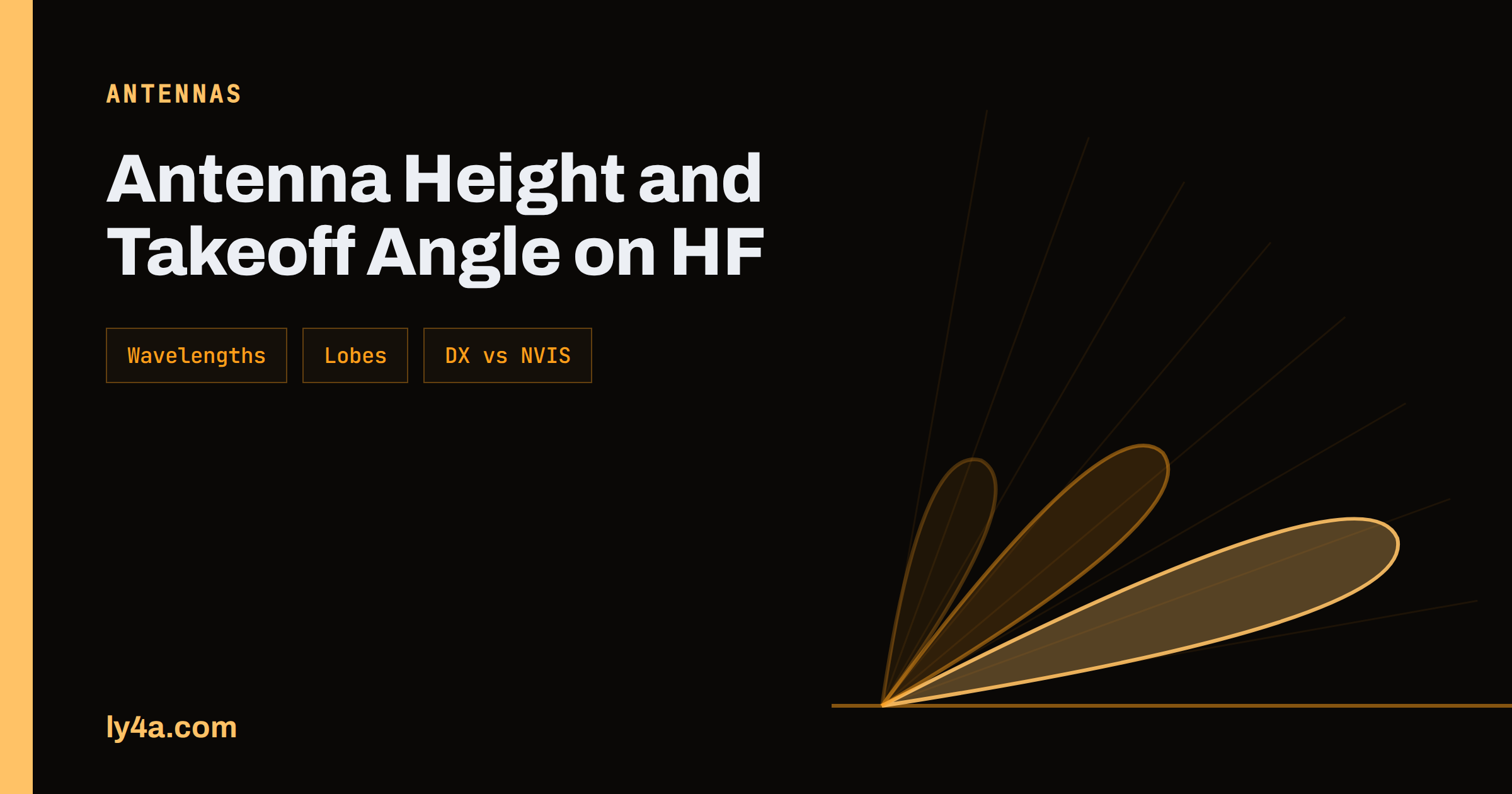
Ask a group of experienced DXers what made the biggest difference to their station and many will give the same answer: getting the antenna higher. Antenna height is one of the few changes that can transform a station without spending money on a new radio or amplifier. But “higher is better” is only partly true. Height changes the angle at which your signal leaves for the ionosphere, and the right angle depends on where you want to be heard.
This guide explains how height affects the takeoff angle of HF antennas, why height should be measured in wavelengths rather than metres, what changes for vertical antennas, and how to choose a practical height for your goals and your property. It avoids precise figures that depend on your band, ground and terrain; for those, antenna modeling of your own situation gives better answers than any rule of thumb.
What Takeoff Angle Means
The takeoff angle, also called the elevation angle or radiation angle, is the angle above the horizon at which an antenna sends most of its energy. A signal leaving at a low angle travels a long way before it reaches the ionosphere and comes back down, so each hop covers a long distance. A signal leaving at a high angle comes back down closer to you.
That is the core idea behind skywave propagation: the geometry of the path depends on the angle at which the signal reaches the ionosphere, and on which layer refracts it. For long-distance DX, low angles usually help, because fewer hops are needed and each hop involves losses. For regional contacts within a few hundred kilometres, high angles are what you want.
No antenna radiates at a single angle. Every antenna has an elevation pattern: a shape that shows how strong the signal is at each angle above the horizon. When people talk about the takeoff angle, they usually mean the angle of the strongest lobe in that pattern. Our article on what really decides whether you are heard on HF covers the propagation side; this article focuses on what the antenna contributes.
Why Height Changes the Pattern
A horizontal antenna above ground does not radiate on its own. The ground below acts as a reflector. Part of the energy goes directly towards the horizon, and part goes down, reflects from the ground and travels upward. At some angles these two waves add together, and at others they cancel. The result is a set of lobes and nulls in the elevation pattern.
The spacing between the antenna and its reflection, in other words the height, decides at which angles reinforcement happens. Raise the antenna and the main lobe moves lower towards the horizon. Lower the antenna and the main lobe moves upward until, at very low heights, most of the energy goes almost straight up.
Two practical consequences follow:
- Height must be measured in wavelengths. A wire at 10 metres is relatively high on 10 metres, moderate on 20 metres, and low on 80 metres. The same physical height produces completely different patterns on different bands.
- Higher antennas develop more lobes. As a horizontal antenna goes well above about one wavelength, additional higher-angle lobes appear, with nulls between them. Height brings a lower main lobe, but also gaps at some angles.
To translate height into wavelengths, divide 300 by the frequency in MHz to get the wavelength in metres. On 14 MHz one wavelength is a little over 21 metres; on 3.5 MHz it is more than 85 metres. That simple calculation explains why low band DX antennas are so hard to get “high” and why 20 metre beams on modest towers can perform so well.
Height in Wavelengths: A Practical Comparison
The table below summarises how a horizontal wire or beam typically behaves at different heights in wavelengths. It is qualitative on purpose: exact angles depend on ground quality, terrain and antenna type, and should come from modeling your own setup.
| Height above ground | Typical elevation pattern | What it is good for |
|---|---|---|
| Very low, roughly 1/20 to 1/4 wavelength | Most energy goes nearly straight up | NVIS: regional coverage without a skip zone |
| Around 1/4 to 1/2 wavelength | Broad main lobe at medium to high angles | General operating, medium-distance contacts, some DX |
| Around 1/2 to 1 wavelength | Main lobe moves lower, pattern becomes more useful for DX | All-round DX and contest operating on the higher bands |
| Above about 1 wavelength | Low main lobe plus extra higher lobes and nulls | Long-haul DX, often combined with stacked or switchable antennas |
The NVIS row is the best documented. According to the Wikipedia article on NVIS, NVIS antennas are typically mounted between about 1/20 and 1/4 wavelength above the ground, which pushes the radiation nearly straight upward. Our own guide to NVIS propagation explains when that is exactly what you need.
Matching Height to Your Goals
Before deciding that your antenna must go higher, decide what you want it to do. Different goals call for different angles, and therefore different heights.
Regional nets and emergency communication
If most of your contacts are within your own country or neighbouring ones on 80 and 40 metres, a low wire is not a compromise; it is the right tool. High angle radiation fills in the area that a high antenna would skip over. Many operators who complain that their “high” 80 metre dipole hears local stations poorly are seeing the opposite effect: their antenna favours lower angles than their regional contacts need.
General operating on several bands
A wire that is moderately high on the higher bands and low on the lower bands is a reasonable all-round compromise. It will be good for DX on 20 metres and above, and good for regional work on 80 metres. This is the situation of most backyard dipoles and doublets, and it works better than its reputation suggests. A multiband doublet is a classic example, as our article on the doublet antenna with ladder line describes.
Serious DX and contesting
For consistent long-distance contacts, especially on 20 metres and above, height pays. A beam or dipole raised from a fraction of a wavelength to around one wavelength will usually show a clear improvement on long paths. Contest stations go further, using several antennas at different heights so they can switch between angles as conditions change through the day.
Vertical Antennas: A Different Story
Verticals behave differently. A vertical radiates little energy straight up and naturally has a low-angle pattern, which is why it is a popular DX antenna on the low bands, where getting a horizontal wire high enough in wavelengths is impractical.
For a ground-mounted vertical, the factor that matters most is not height but ground. The quality of the ground around the antenna affects both efficiency and how much low-angle radiation survives. That is why radial systems matter so much, and why verticals near salt water are famous for strong low-angle signals. If you use a vertical, your effort is usually better spent on radials than on raising the base. Our guide to vertical antenna radials covers the practical side.
Elevated verticals and ground planes are a middle ground: raising the radiator and its radials clears nearby obstructions and can reduce some ground losses, but they still depend on the ground in the far field for their low-angle performance.
Ground and Terrain Change the Answer
Everything above assumes flat ground. Real locations are not flat, and terrain can change the effective height of an antenna dramatically in a particular direction.
- A slope falling away from you in the direction you want to work effectively makes your antenna higher in that direction and lowers the useful takeoff angle.
- Rising ground or a hill in that direction does the opposite, blocking or raising the angles that get through.
- Ground conductivity affects how strongly the reflection reinforces the direct wave, particularly at low angles.
- Nearby buildings, trees and metal structures absorb and distort the pattern, and a nearby metal roof can act as a reflector of its own.
This is why two stations with identical antennas at identical heights can perform differently. If you have a choice of mounting points, consider which one offers clear terrain in the directions you care about most, not just which one is tallest.
Model Before You Climb
You do not need to guess. Free and low-cost antenna modeling programs can show the elevation pattern of your antenna at different heights over different types of ground in a few minutes. Model the antenna at the height you have now, then at the height you could realistically reach, and compare the patterns at the angles that matter for your target paths.
Our walkthrough on antenna modeling with EZNEC and 4nec2 shows how to set up a basic model and read the elevation plot. Combine that with propagation prediction tools such as VOACAP, which estimate the angles involved for a given path, and you can see whether raising your antenna is worth the effort before you rent a ladder.
Getting Height Safely
Height is useful only if you can achieve it safely. Every metre gained adds wind load, stress on supports and risk during installation. A few principles apply to every installation:
- Never place an antenna or support where it could fall onto, or come into contact with, power lines.
- Use supports, guying and hardware rated for the loads involved, and inspect them regularly.
- Avoid climbing alone, and use proper fall protection when climbing towers.
- Check local planning rules, landlord or neighbour agreements and insurance before putting up a tall structure.
The ARRL antenna safety pages collect practical guidance worth reading before any significant antenna project. Often, a modest gain in height achieved safely, such as a higher tree branch or a well-guyed mast, is the best value improvement available.
Cheap Ways to Gain Effective Height
If a tower is out of the question, there are still ways to make the most of the height you have:
- Raise the centre or the ends. An inverted V with a higher apex, or a sloping wire that uses the tallest available support, often performs better than a flat wire pulled down by a poor support.
- Use the right antenna for the band. On the low bands, a vertical with a good radial system may give you more low-angle radiation than a wire you cannot raise high enough.
- Choose higher bands for DX. If your height is limited, it is relatively greater on 15 and 10 metres. When those bands are open, your antenna is effectively “high”.
- Clear the surroundings. Moving an antenna away from buildings and metal objects can help as much as a small increase in height.
- Use separate receive and transmit solutions. On the low bands, dedicated receiving antennas can improve what you hear even when your transmit antenna remains low.
The Bottom Line
Antenna height controls the takeoff angle of horizontal antennas, and the takeoff angle decides which distances your signal favours. Measure height in wavelengths, not metres: the same wire can be high on 10 metres and low on 80 metres. Very low antennas are ideal for regional NVIS work, antennas around half a wavelength to one wavelength high suit general DX operating, and heights above a wavelength bring lower main lobes along with extra lobes and nulls. Verticals depend more on ground and radials than on height. Model your real situation, consider terrain and obstructions, and gain height safely. Matching the angle to your goals often improves results more than any new piece of equipment.
Frequently Asked Questions
How does antenna height affect takeoff angle?
For horizontal antennas, the ground acts as a reflector. Raising the antenna moves the main lobe of the elevation pattern towards lower angles, which favours long-distance contacts. Lowering it pushes radiation upward, favouring regional contacts.
Why should antenna height be measured in wavelengths?
Because the pattern depends on height relative to the wavelength. The wavelength in metres is roughly 300 divided by the frequency in MHz, so the same physical height is high on 10 metres and low on 80 metres.
Is a low dipole useless?
No. A low dipole sends most of its energy upward, which is ideal for regional contacts and NVIS. It is less effective for long-distance DX, where lower takeoff angles are usually needed.
Does height matter for vertical antennas?
Much less than for horizontal antennas. A ground-mounted vertical already has a low-angle pattern, and its performance depends mainly on the ground and the radial system around it.
Can an antenna be too high?
For some paths, yes. Very high horizontal antennas develop extra lobes and nulls, so certain angles may be poorly covered. Contest stations solve this with several antennas at different heights.
How can I find the best height for my station?
Model your antenna at the heights you can realistically reach, over your type of ground, and compare the elevation patterns at the angles your target paths need. Then add terrain and safety considerations.