CQ WPX Contest: How Prefixes Become Multipliers
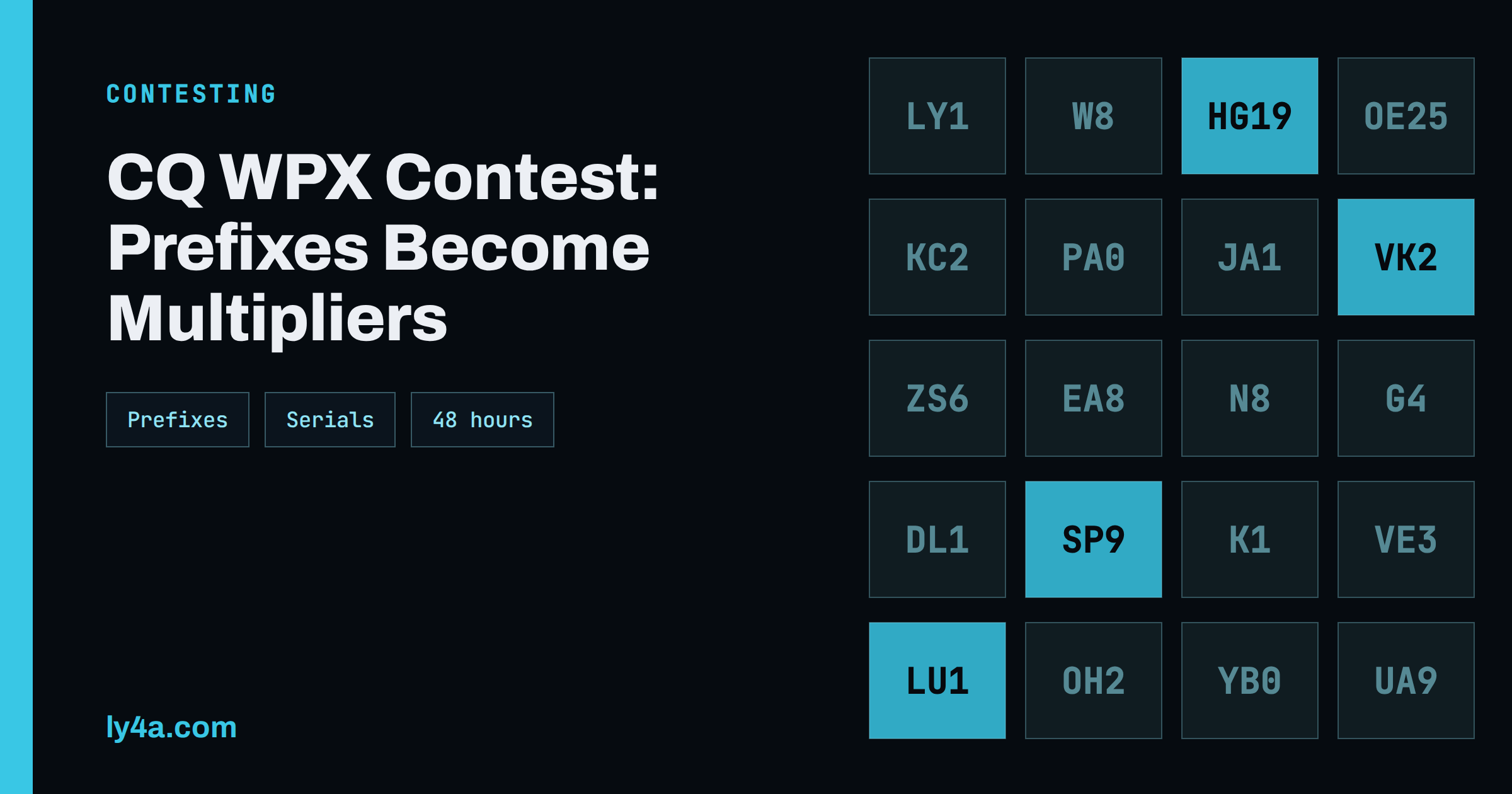
Most big DX contests reward you for working distant countries or zones. The CQ WPX Contest takes a different approach: every distinct callsign prefix is a multiplier. That one rule changes everything about how the contest feels. A station in your own country with an unusual prefix can be worth as much to your score as a rare DX entity, special event calls become valuable, and a well-run station on any continent can build a large multiplier total without ever working an exotic location.
This guide explains how the CQ World-Wide WPX Contest works and how to approach it as a newcomer or a casual competitor. The rules quoted here come from the official CQ WPX rules page. Rules can change from year to year, so always read the current version before the contest weekend rather than relying on memory or on any article, including this one.
What the CQ WPX Contest Is
The CQ World-Wide WPX Contest is organised by CQ magazine and runs as separate SSB and CW weekends, with a separate CQ WPX RTTY contest as well. In the 2026 rules the phone weekend fell at the end of March and the CW weekend at the end of May. Each event starts at 0000 UTC on Saturday and ends at 2359 UTC on Sunday.
The stated objective is simple: for amateurs worldwide to contact as many amateurs and prefixes as possible during the contest period. Anyone can work anyone. There are no “domestic only” or “DX only” restrictions, which makes WPX one of the friendliest big contests for stations with modest antennas.
Only the 160, 80, 40, 20, 15 and 10 metre bands are used (1.8, 3.5, 7, 14, 21 and 28 MHz in the rules). The WARC bands are not part of the contest, and the rules strongly encourage observance of established band plans.
How Prefixes Become Multipliers
The prefix multiplier is the number of valid prefixes worked. Each prefix counts once, regardless of the band or how many times you work it. That is a key difference from contests where multipliers count separately on each band.
What counts as a prefix
The rules define a prefix as the letter and numeral combination that forms the first part of the call. Their examples include N8, W8, WD8, HG1, HG19, KC2, OE2, OE25 and LY1000. Any difference in the numbering, lettering or order counts as a separate prefix, so W8 and WD8 are two different multipliers, and so are OE2 and OE25.
Portable and unusual callsigns
Portable operation follows specific rules:
- When a station signs portable in another call area or country, the portable designator becomes the prefix. It must be an authorised prefix of the country or call area of operation.
- A portable designator without a number gets a zero added after the second letter. The rules’ example is PA/N8BJQ, which counts as PA0.
- A call without any number gets a zero after the first two letters. The example given is XEFTJW, which counts as XE0.
- Maritime mobile, mobile, /A, /E, /J, /P and other licence class identifiers do not count as prefixes.
Special event, commemorative and other unique prefix stations are encouraged to take part, provided the prefix is issued or permitted by the licensing authority of the country of operation. Those stations are often in high demand during WPX, because their prefixes are rare by definition.
QSO Points: Why Low Bands and Other Continents Pay More
Your final score is total QSO points multiplied by the number of different prefixes worked. A station may be worked once on each band for QSO point credit. The points depend on the band and on where the other station is.
| Contact type | 28, 21 and 14 MHz | 7, 3.5 and 1.8 MHz |
|---|---|---|
| Different continents | 3 points | 6 points |
| Same continent, different countries | 1 point | 2 points |
| Within North America (North American stations only) | 2 points | 4 points |
| Same country | 1 point | 1 point |
Two consequences shape strategy. First, low band QSOs are worth double, so time on 40, 80 and 160 metres at night is valuable even when rates are lower than on 20 metres. Second, inter-continental contacts are worth three times as much as contacts within your own continent on the high bands. A European station with a good opening to North America or Asia can raise the point value of each QSO dramatically.
Same-country contacts are worth only one point, but they still count for prefixes. Working a station in your own country with a prefix you need is often worth it for the multiplier alone.
The Exchange: RS(T) Plus a Serial Number
The exchange is a signal report plus a progressive serial number starting with 001 for the first contact. On SSB that means “59 001”, on CW “599 001”, and so on through the weekend.
Serial numbers add a little challenge compared with fixed exchanges, because every QSO is different. A few practical points:
- Let the logging program generate and send your number. Typing serials by hand is a reliable way to make mistakes.
- Copy the other station’s number carefully. Busted serial numbers cost points during log checking.
- Multi-Two, Multi-Unlimited and Multi-Distributed entrants use separate serial number sequences on each band; single operators and Multi-Single stations use one sequence for the whole log.
Accuracy matters more than you might expect. The rules state that correction of logged callsigns and exchanges after the contest using databases, recordings, email or other methods of confirming QSOs is not allowed. Log what you heard, as you heard it. Our article on Cabrillo logs and the UBN process explains how log checking turns small copying errors into lost points.
Categories, Overlays and the 36-Hour Rule
The contest lasts 48 hours, but single operator stations may operate only 36 of them. Off times must be at least 60 minutes, during which no QSO is logged. Multi-operator stations may operate the full 48 hours.
That off-time rule makes WPX a planning exercise. Twelve hours of rest must be placed where they cost you the least, usually during the hours when your bands are weakest. Our guide to rest and time management in 24 and 48 hour contests covers how to plan those breaks.
Single operator categories
Single operator entries can be all band or single band, in three power classes: High Power (total output not over 1500 watts), Low Power (not over 100 watts) and QRP (not over 5 watts). There is no limit on band changes, and only one transmitted signal is permitted at any time. Use of QSO alerting assistance such as DX clusters is permitted in all categories except the Classic overlay.
Overlay categories
Single operators can also enter one overlay category by adding a CATEGORY-OVERLAY line to the Cabrillo header:
- Tribander/Single Element (TB-WIRES): one tribander for 10, 15 and 20 metres and single-element antennas on 40, 80 and 160 metres, with no separate receiving antennas.
- Rookie: licensed for three years or less on the date of the contest, with the first licence date noted in the soapbox field.
- Classic: one radio, up to 24 of the 48 hours, and no QSO alerting assistance of any kind.
- Youth: operator aged 25 or younger at the start of the contest.
The Rookie and Tribander/Single Element overlays are good options for newer contesters, because you compete against stations with similar experience or equipment. For a broader explanation of how contest classes work, see our guide to ham radio contest categories.
Multi-operator categories
Multi-operator entries are all band only. Multi-One allows one transmitted signal at a time and a maximum of ten band changes per clock hour. Multi-Two allows two signals on two different bands, with up to eight band changes per transmitter per clock hour. Multi-Unlimited and Multi-Distributed allow up to six signals, one per band. Each has its own logging and serial number requirements described in the rules.
Rules That Catch Newcomers
A few general rules deserve attention because they are easy to break by accident:
- No self-spotting. Self-spotting or asking to be spotted is not permitted.
- One signal per band. Only one signal on a band is allowed at any time, and alternating CQs on two or more frequencies on a band is not permitted.
- Region 1 band limits. ITU Region 1 stations may not transmit above 7200 kHz on 40 metres during the SSB weekend, or below 1810 kHz during either weekend.
- Human operator. A human must initiate frequency changes, calling a QSO partner and logging a QSO. Autonomous systems that emulate these actions are prohibited.
- Power is measured at the final output. Do not exceed your category’s limit on any band at any time.
A Simple Strategy for Your First WPX
You do not need a big station to enjoy WPX or to turn in a respectable score. A plan helps far more than raw hardware.
Before the weekend
- Read the current rules and choose a category, including an overlay if you qualify.
- Configure your logger for WPX so that it sends serial numbers and tracks new prefixes automatically. Most contest loggers support WPX out of the box.
- Decide roughly where your 12 hours off will go, using what you know about your bands at each time of day.
- Test your station: CAT control, voice keyer or CW messages, and antenna switching.
During the contest
- Mix running and search-and-pounce. Because every prefix counts once, tuning the bands to find new prefixes is productive throughout the weekend, not just at the start. If you can hold a frequency and get answers, running is usually the faster way to build QSO points. Our article on run or search and pounce explains the trade-off.
- Use the low bands at night. The doubled QSO points on 40, 80 and 160 metres make evening and night operating especially worthwhile.
- Chase unusual prefixes. Special event calls, newly issued prefixes and portable operations in other call areas are all multipliers.
- Stay accurate. A busted callsign or serial number can cost you the QSO and, in some cases, an extra penalty during log checking.
Submitting Your Log
Electronic submission is required for all entrants, and web upload is the only method. The log must show, for each contact, the date and time in UTC, the frequency or band, the callsign worked, and the exchange sent and received. Cabrillo is the standard format; the WPX Cabrillo instructions explain the header fields, including category and overlay lines. Errors in the header can put your entry in the wrong category or turn it into a checklog.
The deadline is short. The rules require entries within 48 hours after the end of the contest, and late logs may be listed but are not eligible for awards. Upload as soon as you have checked the header, then look for your call on the logs-received list.
Even if you only make a few dozen QSOs, submitting a log helps the log checkers and puts your call in the results. Single band entrants must include all their contacts, even those on other bands, and a station that does not want a score can submit a checklog. Electronic certificates are available for everyone who submits an on-time entry.
WPX Compared With CQ WW
Many operators first meet CQ magazine contests through the CQ WW DX Contest in the autumn. The two share an organiser and a similar feel, but they reward different things. In CQ WW, multipliers are zones and countries counted per band, and the exchange is a signal report and CQ zone. In WPX, multipliers are prefixes counted once for the whole contest, and the exchange includes a serial number. If you have already read our CQ WW DX first-timer’s guide, the main adjustment for WPX is to think in prefixes rather than entities.
The Bottom Line
The CQ WPX Contest rewards activity, accuracy and good planning more than rare locations. Every distinct prefix is a multiplier counted once, low band contacts are worth double, inter-continental QSOs are worth three times as much on the high bands, and single operators must fit 12 hours of rest into the 48-hour weekend. Read the current rules, pick a category and overlay that suit your station, let your logger handle serials and prefixes, and submit your Cabrillo log within 48 hours. Whether you aim for a top score or a few hundred QSOs, WPX is one of the most accessible big contests on the calendar.
Frequently Asked Questions
When is the CQ WPX Contest held?
The SSB and CW weekends are held separately; in 2026 the SSB weekend was at the end of March and the CW weekend at the end of May. Each runs from 0000 UTC Saturday to 2359 UTC Sunday. Check the official rules for the next dates.
What is the exchange in the CQ WPX Contest?
The exchange is an RS or RST signal report plus a progressive serial number starting with 001. Multi-Two, Multi-Unlimited and Multi-Distributed stations keep separate serial sequences for each band.
Does a prefix count again on each band?
No. Each prefix counts once as a multiplier, regardless of band or how many times you work it. You can still earn QSO points by working the same station once on each band.
How many hours can a single operator work?
Single operator stations may operate 36 of the 48 hours. Off times must be at least 60 minutes long with no QSO logged. The Classic overlay is limited to 24 hours.
Can I use a DX cluster in WPX?
Yes, QSO alerting assistance is permitted in all categories except the Single Operator Classic overlay. Self-spotting or asking to be spotted is not permitted in any category.
How quickly must I submit my log?
Within 48 hours after the end of the contest, by web upload, preferably in Cabrillo format. Late logs may be listed in the results but are not eligible for awards.